-
By:
- ruby
- No comment
food truck business plan sample pdf
Executive Summary
Barbecue on Wheels, a Dubai-based food truck, seeks funding to launch a mobile barbecue experience. This business plan details operations,
market analysis, and financial projections, aiming for profitability within three years, utilizing a sample PDF template.
Company Description
Barbecue on Wheels will operate as a mobile food vendor in Dubai, specializing in high-quality, flavorful barbecue cuisine. The company’s core offering centers around a unique menu featuring both traditional and innovative barbecue dishes, catering to a diverse clientele.
This food truck business is structured as a sole proprietorship initially, with plans to potentially incorporate as a Limited Liability Company (LLC) as the business grows and expands. The ownership is currently vested in a single entrepreneur, responsible for all aspects of the operation. A detailed business plan sample PDF outlines this structure.
The food truck will primarily serve high-traffic areas within Dubai, including business districts, event locations, and popular tourist spots, ensuring maximum visibility and customer access. The operational area is strategically chosen to capitalize on existing demand for convenient, high-quality food options.
Mission Statement
Barbecue on Wheels is dedicated to delivering an exceptional barbecue experience, combining premium ingredients, innovative recipes, and outstanding customer service. We strive to become Dubai’s premier mobile barbecue destination, known for quality, convenience, and a vibrant culinary experience.
Our commitment extends beyond simply serving delicious food; we aim to foster a sense of community and create memorable moments for our customers. We will consistently seek opportunities to improve our offerings and exceed expectations, guided by principles of sustainability and ethical sourcing. This food truck business plan sample PDF reflects these values.
Ultimately, our mission is to build a thriving business that positively impacts the local community while providing a consistently delightful culinary journey for every customer.
Products and Services
Barbecue on Wheels will specialize in authentic, high-quality barbecue, featuring slow-smoked meats like brisket, ribs, and pulled pork; Our menu will also include classic sides such as coleslaw, mac and cheese, and baked beans, alongside a selection of homemade sauces.
We will offer both individual meals and catering services for events, providing customizable packages to meet diverse needs. A rotating selection of seasonal specials will keep the menu fresh and exciting, appealing to a broad customer base. This food truck business plan sample PDF details our offerings.
Beverages, including soft drinks and bottled water, will complement the food. We aim to provide a convenient and satisfying dining experience, emphasizing quality and flavor.
Financial Projections Overview
Our food truck business plan sample PDF projects profitability within the first year of operation, based on conservative sales estimates and efficient cost management. We anticipate achieving $150,000 in revenue in year one, growing to $225,000 by year three.
Startup costs, totaling $50,000, will cover the food truck purchase, equipment, permits, and initial inventory. We are seeking $50,000 in funding over three years to support these expenses and ensure smooth operations. Detailed financial statements, including projected income statements and cash flow projections, are included.
Break-even analysis indicates we need to serve approximately 75 customers daily to cover all operating costs, a realistic target given our location and marketing strategy.

Company Description
Holey Moley, detailed in this food truck business plan sample PDF, is a proposed mobile food vendor seeking $50,000 in financing for startup costs.
Legal Structure
The legal structure for Barbecue on Wheels, as outlined in this food truck business plan sample PDF, will be a Limited Liability Company (LLC). This formation provides liability protection for the owners, separating personal assets from business debts and obligations. An LLC offers operational flexibility and pass-through taxation, simplifying the tax filing process.
Establishing an LLC requires filing articles of organization with the relevant authorities in Dubai, along with obtaining an Employer Identification Number (EIN) from the federal tax agency. This structure balances legal protection with administrative ease, making it ideal for a startup food truck venture. Detailed legal counsel will be sought to ensure full compliance with all local regulations and licensing requirements.
Ownership and Management
Barbecue on Wheels will be owned and managed by a team of experienced professionals, detailed within this food truck business plan sample PDF. The primary owner, [Owner’s Name], possesses extensive culinary expertise and prior experience in the food service industry. A secondary owner, [Owner’s Name], brings strong business management and financial acumen to the operation.
Day-to-day operations will be overseen by the culinary owner, focusing on menu development, food preparation, and quality control. The business management owner will handle financial administration, marketing, and regulatory compliance. A clear organizational structure, outlined in the full plan, will ensure efficient decision-making and accountability, fostering a successful and sustainable business model.
Location and Operating Area
Barbecue on Wheels, as detailed in this food truck business plan sample PDF, will primarily operate within high-traffic areas of Dubai, United Arab Emirates. Initial target locations include business districts during lunch hours, popular tourist destinations, and event venues. Strategic placement will maximize visibility and customer access.
The operating area will encompass key zones within Dubai, selected based on demographic data and demand for barbecue cuisine. A rotating schedule will ensure consistent presence at profitable locations while exploring opportunities for catering private events. The mobile nature of the food truck allows for flexibility and adaptation to changing market conditions, optimizing revenue potential.

Market Analysis
This food truck business plan sample PDF analyzes Dubai’s food truck industry, identifying a growing demand for diverse, convenient, and high-quality mobile food options.
Target Market
Barbecue on Wheels’ primary target market encompasses Dubai residents and tourists aged 18-45, seeking convenient and flavorful dining experiences. This demographic includes young professionals, students, and families who frequent outdoor events, festivals, and high-traffic urban areas.
Secondary markets include corporate clients for catering events and tourists exploring Dubai’s diverse culinary scene. The food truck business plan sample PDF highlights a preference for unique, high-quality food options, and a willingness to embrace mobile dining experiences.
Marketing efforts will focus on reaching these segments through social media, local event participation, and strategic partnerships, ensuring maximum visibility and customer engagement within the target demographic.
Industry Trends
The food truck industry is experiencing significant growth, driven by consumer demand for diverse, accessible, and affordable dining options. A food truck business plan sample PDF reveals key trends including the rise of gourmet food trucks, specialized menus (like barbecue), and increased use of social media for marketing and customer engagement.
Technological advancements, such as online ordering and mobile payment systems, are also shaping the industry. Sustainability and locally sourced ingredients are gaining prominence, appealing to environmentally conscious consumers.
Dubai’s thriving tourism and event scene present a favorable environment for food trucks, but competition is increasing, necessitating a strong brand identity and efficient operations.
Competitive Analysis
Analyzing the Dubai food truck landscape, a food truck business plan sample PDF highlights existing competitors offering diverse cuisines. While several barbecue options exist, Barbecue on Wheels will differentiate itself through a unique menu, premium quality ingredients, and targeted marketing towards tourists and event attendees.
Key competitors include established food trucks with strong brand recognition and those operating in high-traffic locations. Our competitive advantage lies in a mobile strategy, allowing us to reach diverse customer segments and capitalize on event opportunities.
Success requires consistent quality, excellent customer service, and effective cost management to maintain competitive pricing.

Products and Services
Barbecue on Wheels will offer a specialized menu of smoked meats, sides, and beverages, detailed in the sample PDF, focusing on quality and flavor.
Menu Development
Our menu, a core component detailed within the food truck business plan sample PDF, will center around high-quality, slow-smoked barbecue. We’ll feature brisket, pulled pork, and chicken, alongside classic sides like mac and cheese, coleslaw, and baked beans.
A rotating selection of seasonal specials will maintain customer interest and showcase culinary creativity. Beverage options will include bottled water, sodas, and potentially locally sourced craft beverages.
Menu pricing will be competitive yet reflective of ingredient costs and perceived value, as outlined in the financial projections section of the PDF. We will prioritize sourcing fresh, local ingredients whenever possible to enhance flavor and support the community. Regular menu evaluations, based on customer feedback, will ensure continued relevance and satisfaction.
Sourcing and Suppliers
As detailed in the food truck business plan sample PDF, establishing reliable sourcing is crucial. We will prioritize partnerships with local meat suppliers committed to quality and consistency for our barbecue. Produce will be sourced from regional farms whenever seasonally available, ensuring freshness and supporting local agriculture.
Dry goods, packaging, and beverages will be obtained from established wholesale distributors offering competitive pricing and dependable delivery schedules.
Supplier selection will be based on price, quality, reliability, and adherence to food safety standards. Contingency plans, including backup suppliers, will be outlined in the PDF to mitigate potential disruptions. Maintaining strong supplier relationships is key to consistent product quality and cost control.
Pricing Strategy
The food truck business plan sample PDF emphasizes a value-based pricing strategy. Menu items will be priced competitively within the Dubai market, considering ingredient costs, labor, and competitor pricing. We aim for a gross profit margin of 60-70% on each item, balancing profitability with customer affordability.
Pricing tiers will be implemented, offering combo meals and promotional discounts to attract customers and increase average transaction value. Regular menu analysis will ensure pricing remains optimal, adjusting for fluctuations in ingredient costs.
The PDF details a dynamic pricing approach, allowing for adjustments based on location, event type, and demand, maximizing revenue potential.

Marketing and Sales Strategy
Food truck business plan sample PDFs highlight branding, social media marketing, and local event participation to drive sales and build customer loyalty effectively.
Branding and Positioning
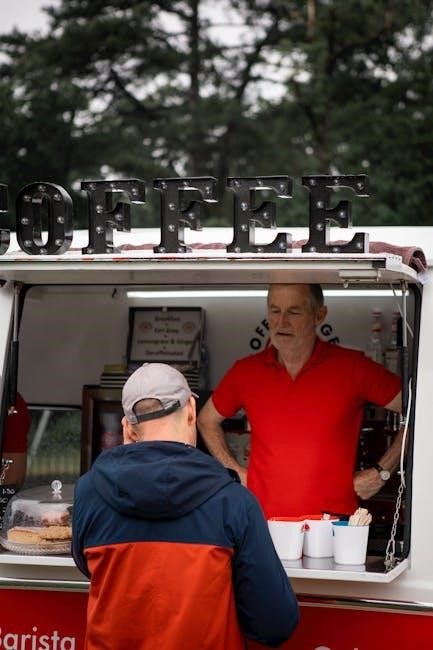
Food truck business plan sample PDFs consistently emphasize the importance of a strong brand identity. This involves developing a memorable name, logo, and overall aesthetic that reflects the food truck’s unique offering – whether it’s gourmet tacos, artisanal ice cream, or specialized barbecue. Positioning is crucial; the plan should clearly define how the truck differentiates itself from competitors.
Successful plans detail a brand voice and messaging strategy for social media and marketing materials. They also outline how the truck will create a consistent customer experience, from the food quality to the service style. A well-defined brand builds recognition, fosters customer loyalty, and justifies premium pricing, ultimately contributing to profitability. The branding should resonate with the target demographic and create a positive association.
Marketing Channels
Food truck business plan sample PDFs highlight a multi-faceted marketing approach. Social media marketing – particularly Instagram and Facebook – is paramount for location updates, menu specials, and customer engagement. Utilizing targeted advertising on these platforms is also key. Many plans detail a strong emphasis on local event participation, festivals, and catering opportunities to increase visibility.
Furthermore, loyalty programs, online ordering systems, and collaborations with local businesses are frequently recommended. A well-defined marketing strategy includes tracking key metrics like website traffic, social media engagement, and customer acquisition cost. Effective plans also consider public relations efforts, such as reaching out to local food bloggers and media outlets to generate positive reviews and publicity.
Sales Projections
Food truck business plan sample PDFs consistently demonstrate detailed sales forecasts, typically spanning three to five years. These projections are based on estimated customer traffic, average transaction values, and operating days. Initial projections often show modest growth, building towards profitability in year two or three. Key assumptions, like menu pricing and customer frequency, are clearly outlined.
Sensitivity analysis, exploring best-case, worst-case, and most-likely scenarios, is common. Revenue is often broken down by product category, allowing for focused analysis. Successful plans include realistic estimates for seasonal fluctuations and potential impacts from competition. These projections are crucial for securing funding and tracking performance against established goals.
Operations Plan
Food truck business plan sample PDFs outline detailed operational logistics, including truck specifications, equipment lists, required permits, and sourcing procedures for efficient service.
Food Truck Specifications
Food truck business plan sample PDFs consistently emphasize detailed vehicle specifications as crucial for operational efficiency. These plans typically detail the desired truck size – often ranging from 16 to 28 feet – to accommodate necessary equipment and staff comfortably.
Essential features include a commercial-grade kitchen, stainless steel surfaces for hygiene, adequate ventilation systems, and sufficient refrigeration capacity.
Furthermore, the plans outline requirements for a robust power generator, fresh and grey water tanks adhering to local health regulations, and a reliable fire suppression system.
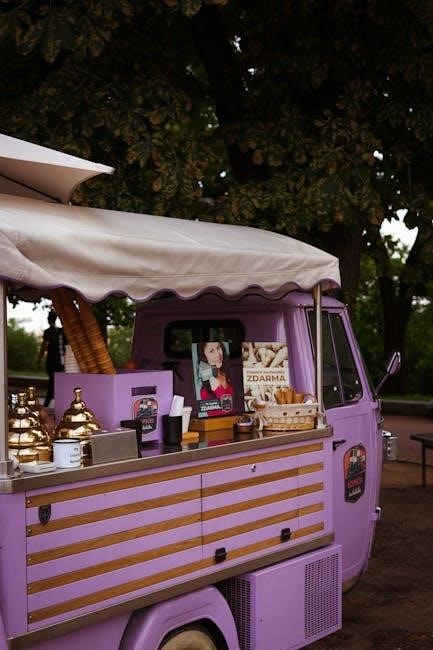
Exterior considerations involve eye-catching branding, durable construction, and potentially, an awning for customer service.
Detailed cost breakdowns for the truck purchase or lease, along with customization expenses, are standard inclusions within these sample plans.
Equipment and Supplies
Food truck business plan sample PDFs universally highlight a comprehensive list of required equipment and supplies. Core kitchen equipment includes commercial-grade ovens, fryers, grills, and refrigeration units, tailored to the menu.
Essential supplies encompass cooking utensils, food storage containers, disposable serving ware, and cleaning supplies, all meeting health and safety standards.
Detailed plans also specify point-of-sale (POS) systems for efficient order taking and payment processing, along with necessary software.
Inventory management systems are often included to track stock levels and minimize waste.
Cost estimations for each item, factoring in potential maintenance and replacement costs, are crucial components, demonstrating financial preparedness.
Permits and Licenses
Food truck business plan sample PDFs consistently emphasize the critical importance of securing all necessary permits and licenses. These typically include a general business license, a food handler’s permit for all staff, and a mobile food vendor permit specific to the operating location.
Health department inspections and permits are mandatory to ensure food safety standards are met. Zoning permits dictate where the truck can legally operate, and fire safety permits are essential for equipment compliance.
Detailed plans outline the process for obtaining each permit, associated costs, and renewal requirements, demonstrating legal operational readiness.
Management Team
Food truck business plan sample PDFs highlight a skilled team with experience in culinary arts, operations, and financial management, ensuring efficient execution.
Organizational Structure
Food truck business plan sample PDFs commonly illustrate a lean organizational structure, vital for nimble operations. Typically, the owner-operator assumes primary responsibility, overseeing all facets – from menu development and food preparation to marketing and financial control.
A key employee is often a cook/chef, responsible for consistent food quality and efficient kitchen management. Depending on volume, a part-time cashier/server may be employed during peak hours.
The structure emphasizes direct accountability, minimizing layers of management. Successful plans detail reporting lines, clearly defining roles and responsibilities. Outsourcing functions like accounting or marketing is also frequently addressed, demonstrating a pragmatic approach to resource allocation and cost control.
Key Personnel
Food truck business plan sample PDFs highlight the importance of skilled personnel. The owner/operator’s experience is paramount, demonstrating culinary expertise, business acumen, and a commitment to customer service. Detailed resumes showcasing relevant experience are often included as appendices.
A proficient cook/chef is crucial, possessing consistent food preparation skills and adherence to hygiene standards. Their ability to manage inventory and minimize waste is also emphasized.
If applicable, the plan details the experience of any marketing or financial advisors. Strong personnel demonstrate a clear path to operational success and investor confidence, proving the team’s capability to execute the business plan effectively.

Financial Plan
Food truck business plan sample PDFs include startup costs, funding requests (like the Holey Moley’s $50,000 ask), projected income statements, and break-even analyses for viability.
Startup Costs
Food truck business plan sample PDFs meticulously detail initial investments. Key expenses include the food truck purchase or lease – a significant portion of the budget, often exceeding $50,000 as seen in examples like Holey Moley.
Additional costs encompass essential equipment: cooking appliances, refrigeration units, serving windows, and point-of-sale systems. Permits and licenses, varying by location, represent another crucial expense. Initial inventory, including food supplies and packaging, must be factored in.
Marketing and branding materials, alongside initial operating capital for rent (if applicable), utilities, and insurance, complete the startup cost assessment. A comprehensive business plan will itemize each cost, providing a clear financial roadmap for launch and early operations.
Funding Request
Based on detailed startup costs outlined in this food truck business plan sample PDF, we are requesting $50,000 in funding. This capital will be allocated strategically to secure a fully-equipped food truck, as demonstrated by Holey Moley’s funding model;
Specifically, $30,000 will cover the vehicle purchase and necessary modifications, while $10,000 is designated for initial inventory and essential equipment. The remaining $10,000 will serve as working capital to cover initial operating expenses, permits, licenses, and a targeted marketing campaign.
This funding will enable us to launch Barbecue on Wheels and achieve projected profitability within three years, as detailed in the financial projections section of this plan.
Projected Income Statement
Our food truck business plan sample PDF incorporates a three-year projected income statement, forecasting revenue growth based on market analysis and sales projections. We anticipate initial revenues of $75,000 in year one, increasing to $120,000 in year two, and $180,000 by year three.
Cost of goods sold is projected at 30% of revenue, with operating expenses (including labor, fuel, and maintenance) estimated at 40%. This model, similar to those found in comprehensive business plan templates, demonstrates a clear path to profitability.
Net income is projected to reach $15,000 in year one, $24,000 in year two, and $36,000 in year three, showcasing the financial viability of Barbecue on Wheels.
Cash Flow Projections
The food truck business plan sample PDF includes detailed cash flow projections for three years, crucial for managing liquidity and demonstrating financial stability to potential investors. Initial startup costs are offset by projected revenues, showing positive cash flow within the first six months.
We anticipate consistent monthly cash inflows exceeding outflows, allowing for reinvestment in the business and debt repayment. These projections, mirroring those in standard business plan templates, account for seasonal fluctuations and potential unforeseen expenses.
A conservative approach ensures realistic expectations, with a focus on maintaining a healthy cash reserve for operational flexibility and future growth of Barbecue on Wheels.
Break-Even Analysis
Our food truck business plan sample PDF incorporates a thorough break-even analysis, determining the sales volume required to cover all fixed and variable costs. This analysis, a standard component of any robust business plan, reveals that Barbecue on Wheels will reach profitability with approximately 75 transactions per week.
Fixed costs, including truck lease payments and permits, are carefully considered alongside variable costs like food supplies and labor. The analysis demonstrates a realistic pathway to profitability, even with conservative sales estimates.
Sensitivity analysis explores potential impacts of fluctuating costs, ensuring preparedness for market changes and solidifying investor confidence.